
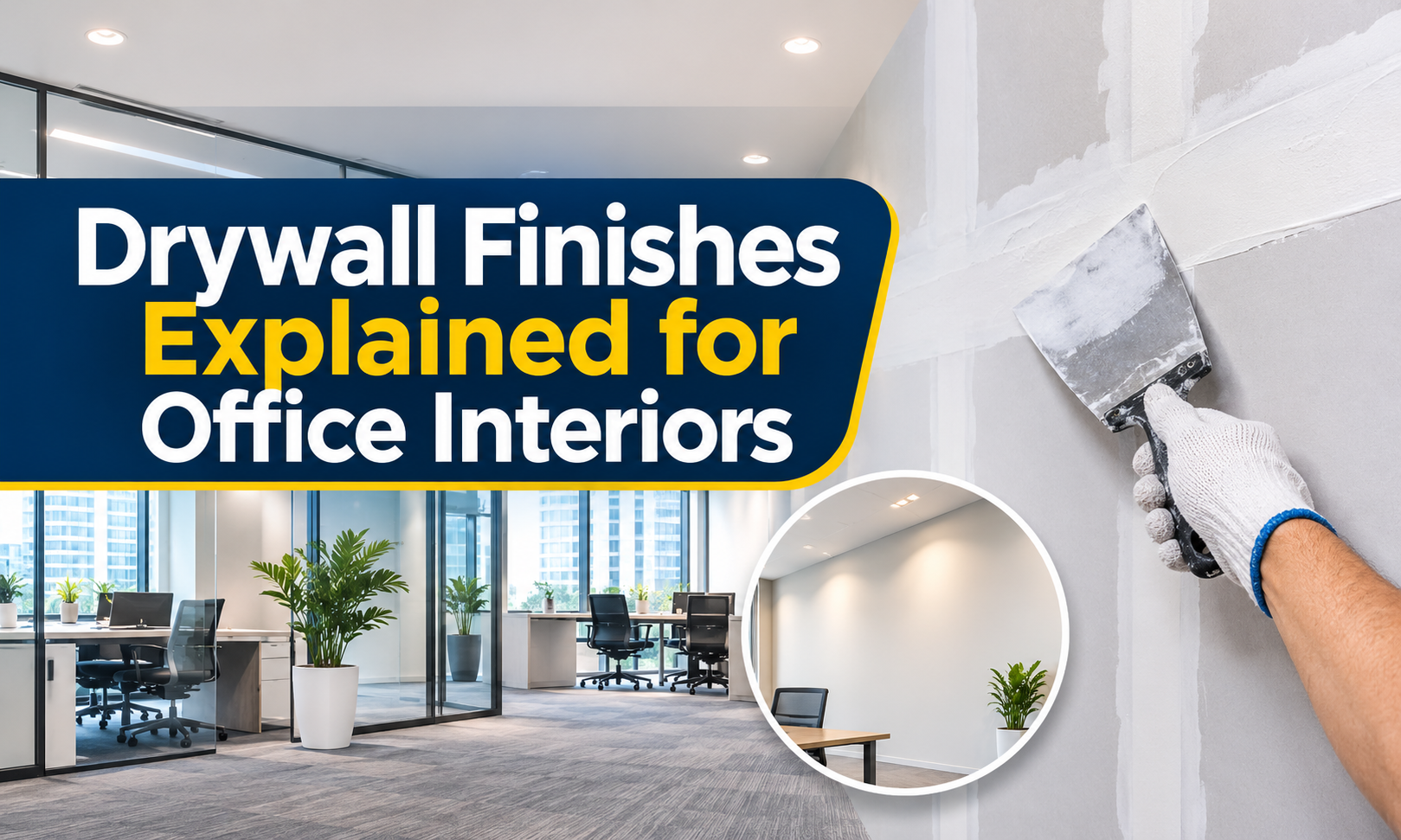
The appearance of office walls plays an important role in creating a professional, comfortable, and welcoming workplace. From corporate headquarters to meeting rooms and collaborative workspaces, properly finished drywall helps establish a clean interior that complements the company’s brand and design goals. However, achieving the right appearance requires more than applying paint to a wall. The finishing level, surface preparation, lighting conditions, and paint selection all influence the final result.
Understanding drywall finish levels helps property owners, architects, designers, and contractors choose the right surface quality for each space. While some office areas can accommodate a basic finish, executive offices, reception areas, and conference rooms often require a smoother, more refined appearance.
This guide explains the different drywall finishing levels, how lighting affects wall appearance, and what to consider when selecting office wall finishes for commercial interiors.
What Are Drywall Finishing Levels?
Drywall finishing describes the process of treating joints, seams, fasteners, and other imperfections after drywall panels are installed. Contractors typically apply joint compound, embed drywall tape, smooth the surface, and prepare the wall for its final coating.
The industry commonly uses five finishing levels, ranging from Level 0 to Level 5. Each level serves a different purpose depending on the intended wall covering, lighting, and overall design expectations.
Level 0: Basic Installation
Level 0 involves installing drywall panels without taping or finishing the joints. It is generally suitable for temporary construction conditions or areas where additional finishing will happen later.
Level 1: Minimal Finishing
At Level 1, tape is embedded in joint compound, but the surface receives minimal additional treatment. It is typically used in concealed areas such as certain ceiling spaces or service areas where appearance is not a priority.
Level 2: Basic Joint Finishing
Level 2 includes tape embedded in compound and a thin covering over joints and fasteners. It may be suitable for some utility spaces that will receive a heavy texture or another approved covering.
Level 3: Textured Wall Preparation
Level 3 includes additional compound over joints and fasteners, producing a more developed surface. It is generally intended for textured finishes or applications where a completely smooth appearance is unnecessary.
Level 4: Standard Smooth Finish
Level 4 is commonly used for ordinary painted walls and ceilings where the lighting and paint requirements are not especially demanding. Joints and fasteners receive additional compound coats, followed by sanding and preparation.
This level can work well in general office areas, storage rooms, and corridors when the specified paint and lighting conditions are appropriate.
Level 5: Premium Surface Finish
A level five drywall finish includes the normal Level 4 treatment plus a thin skim coat of joint compound across the entire surface, or an approved equivalent. This helps create a more uniform substrate and reduces the visibility of minor surface variations.
It is frequently specified for high-visibility commercial interiors, especially where smooth walls, dark paint, gloss coatings, or critical lighting conditions demand greater consistency.
Choosing the Right Finish for Office Interiors
Not every office needs the same finishing standard. Selecting the appropriate finish helps balance appearance, construction costs, and long-term maintenance.
Consider these factors when comparing drywall finish levels:
- Reception areas: Smooth, consistent walls support a polished first impression.
- Conference rooms: High-quality finishes help maintain a professional appearance during meetings and video calls.
- Private offices: Standard smooth finishes may be sufficient, depending on paint selection and lighting.
- Open-plan workspaces: Consistency across large wall surfaces is particularly important.
- Utility and storage areas: Basic finishes may be appropriate when walls are concealed or appearance requirements are limited.
The intended wall covering also matters. Paint generally reveals more surface variation than some textured finishes, while wall coverings have their own substrate preparation requirements.
How Lighting Influences Drywall Appearance
Lighting can make an otherwise acceptable wall appear uneven. Natural light from large windows, wall-mounted fixtures, recessed lights, and linear LED systems can create shadows that highlight joints, ridges, and sanding marks.
These drywall lighting effects are particularly noticeable in modern offices that feature minimalist interiors and uninterrupted wall surfaces.
Common Lighting Challenges
- Raking light: Light traveling almost parallel to a wall can reveal small surface irregularities.
- Large windows: Strong daylight can emphasize inconsistencies as the sun moves throughout the day.
- Glossy paint: Reflective coatings may make surface defects more visible.
- Dark colors: Certain darker finishes can highlight variations in texture and sheen.
Contractors and designers should review lighting plans before drywall finishing begins. A mock-up panel viewed under representative lighting can help confirm whether the proposed finish meets expectations.
Why Smooth Wall Preparation Matters
Effective smooth wall preparation starts before the final paint application. Even a premium finishing level cannot compensate for poor installation, inadequate sanding, or unsuitable environmental conditions.
A reliable preparation process includes:
- Inspecting drywall panels, joints, corners, and fasteners.
- Applying joint tape and compound according to the specified finish.
- Allowing compound to dry properly between coats.
- Sanding carefully to remove ridges without damaging the paper surface.
- Removing dust and checking the wall under suitable lighting.
- Applying the recommended primer before painting.
Temperature, humidity, and drying time can influence compound performance. Contractors should follow product instructions and ensure the building conditions are appropriate before finishing and painting.
The final inspection should consider the agreed finish specification, the intended paint system, and the lighting conditions expected in the completed office.
Popular Office Wall Finishes
The best office wall finishes combine appearance, durability, and ease of maintenance.
Common options include:
- Smooth painted walls: Suitable for contemporary offices, reception spaces, and meeting rooms.
- Matte finishes: Help reduce reflections, although they do not eliminate surface imperfections.
- Eggshell or satin finishes: Offer different levels of sheen and cleanability depending on the product.
- Decorative accent walls: Introduce visual interest through color, texture, or architectural detailing.
- Wallcoverings: Require substrate preparation appropriate to the material and manufacturer’s recommendations.
Choosing a finish should involve more than visual preference. Traffic levels, cleaning requirements, repair access, and future repainting should also influence the specification.
Why Choose Atlas GC for Commercial Interior Finishing?
Atlas GC understands that professional commercial interiors depend on careful planning, skilled workmanship, and attention to detail. Drywall finishing is an important part of creating spaces that look consistent, support daily operations, and align with the intended architectural design.
For office renovation and construction projects, the right approach begins with understanding how each room will be used. A reception area with prominent lighting may require a different specification from a back-office workspace or storage room. Coordinating the finishing requirements with the lighting plan, paint system, and interior design helps establish realistic expectations before work begins.
Atlas GC can help project teams consider surface quality, finishing requirements, and preparation standards when planning commercial interior improvements. Clear communication about the expected appearance is essential, particularly when large wall areas, reflective coatings, or architectural lighting are involved.
A well-planned finishing process can also help reduce avoidable touch-ups, improve consistency between rooms, and support a more professional final presentation. From evaluating the scope of work to coordinating finishing details, the goal is to create commercial spaces that meet the project’s practical and visual requirements.
If you are planning an office fit-out, renovation, or interior upgrade, contact Atlas GC to discuss your project requirements and determine an appropriate drywall finishing specification for your space.
Frequently Asked Questions
1. What are the different drywall finishing levels?
The five commonly recognized levels range from Level 0, which has no joint finishing, to Level 5, which includes a skim coat across the surface. Each level addresses different appearance and application requirements.
2. Which drywall finish is best for an office?
Level 4 is suitable for many standard painted office interiors. Level 5 may be preferable in high-visibility areas or spaces with critical lighting, dark paint, or reflective coatings.
3. Is Level 5 drywall completely flawless?
No. A Level 5 finish improves surface uniformity but does not guarantee a perfectly flawless wall. Installation quality, paint application, lighting, and inspection conditions still influence the final appearance.
4. Can lighting expose drywall imperfections?
Yes. Light that strikes a wall at a shallow angle can emphasize ridges, joints, and uneven areas. Reviewing sample surfaces under the planned lighting helps identify potential problems before painting.
5. Does every office need a Level 5 finish?
No. The appropriate finish depends on the room’s purpose, budget, paint system, lighting, and design expectations. Many ordinary office areas perform well with Level 4.
6. Should drywall be primed before painting?
Yes. Applying a suitable drywall primer helps create a more uniform surface for paint and reduces differences in absorption between drywall paper and joint compound.
7. How can businesses achieve smoother office walls?
Specify the required finish early, hire experienced drywall professionals, allow compounds to dry correctly, inspect surfaces under representative lighting, and use compatible primer and paint products.
Conclusion
Selecting the right drywall finish is essential for creating professional office interiors. From basic utility areas to executive suites and reception spaces, each room has different appearance requirements. Understanding the finishing levels, anticipating lighting challenges, and prioritizing proper surface preparation can help businesses achieve more consistent, attractive results.
For office construction or renovation projects, work with an experienced team to define the desired finish before installation and painting begin. Contact Atlas GC to discuss your commercial interior project and plan a finish that suits your workspace, design objectives, and budget.


