
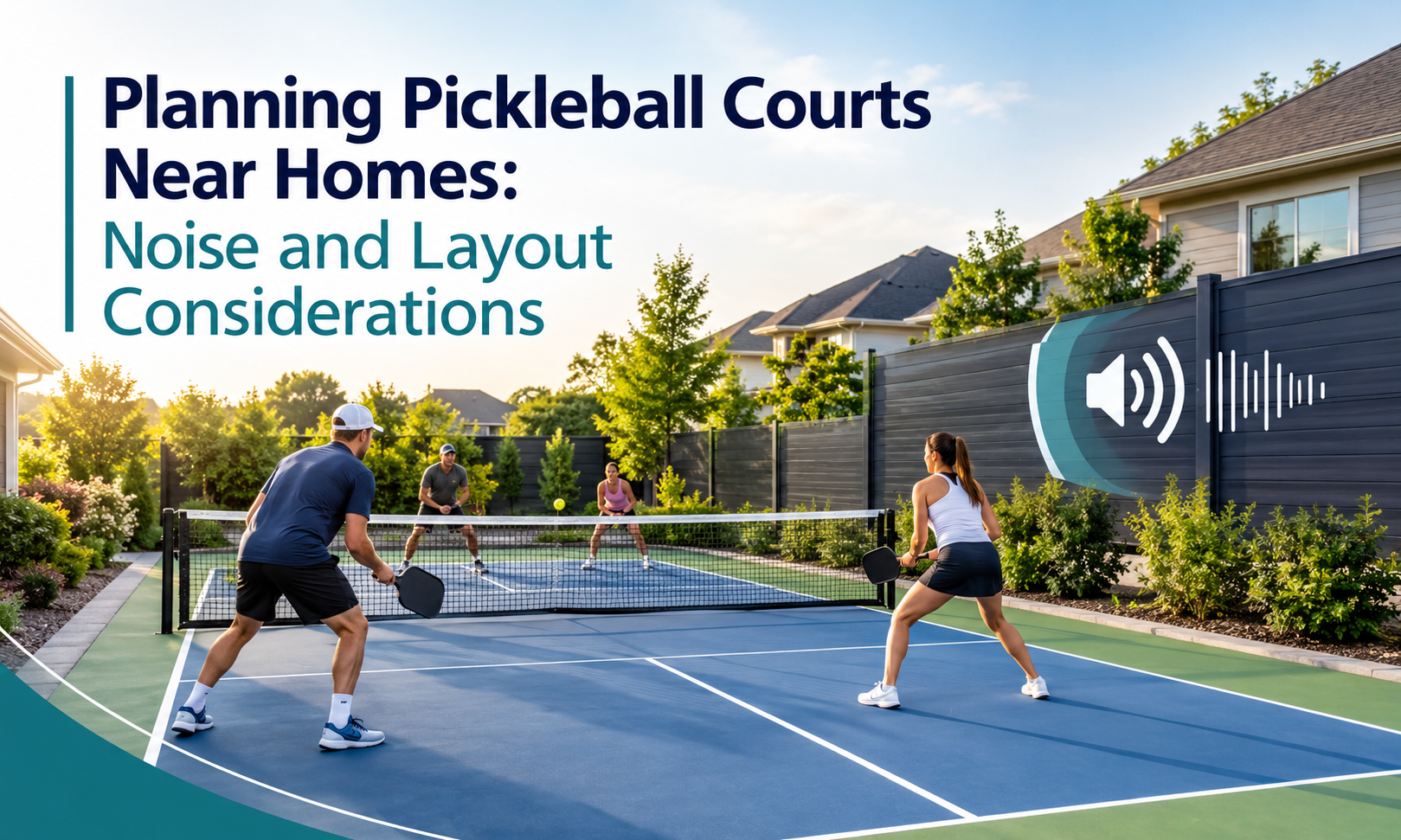
Pickleball is becoming increasingly popular in residential communities, recreational facilities, and private properties. However, building courts close to homes requires more than selecting a suitable surface and installing a net. Noise levels, court positioning, surrounding structures, and neighborhood comfort all play important roles in successful planning.
One of the biggest challenges associated with residential pickleball facilities is pickleball court noise, particularly when courts operate near bedrooms, patios, gardens, and neighboring properties. The repeated sound of paddles striking balls, player conversations, and general activity can become disruptive without proper planning.
Fortunately, thoughtful design can reduce potential disturbances while maintaining an enjoyable playing environment. From residential court placement to effective sound barriers, understanding these considerations helps property owners, developers, and recreational planners make better decisions.
Understanding Noise Challenges Around Residential Courts
Unlike many recreational activities, pickleball involves frequent, sharp paddle-to-ball contact. These repeated sounds can travel beyond the playing area, especially in open environments.
Several factors influence how sound affects nearby homes:
- Distance: Courts positioned close to residential buildings may create greater disturbances.
- Playing frequency: Facilities operating throughout the day and evening generate more consistent noise.
- Court orientation: The direction of play and surrounding structures can influence sound transmission.
- Environmental conditions: Wind, terrain, and reflective surfaces can affect how sound travels.
- Player activity: Conversations, cheering, and movement also contribute to the overall noise environment.
Understanding these factors before construction allows planners to address potential concerns rather than making expensive adjustments afterward.
Choosing the Right Residential Court Placement
Residential court placement is one of the most important decisions in recreational facility planning. A well-positioned court can help minimize noise exposure while making efficient use of available land.
Maintain Adequate Distance From Homes
Whenever possible, position courts away from neighboring houses, particularly bedrooms, balconies, and outdoor relaxation areas.
Greater separation can help reduce the intensity of sound reaching residential spaces. However, there is no universal setback distance suitable for every property. Local zoning regulations, property dimensions, and acoustic assessments should guide the final placement.
Consider Court Orientation
Court orientation can influence how sound moves through a property. Avoid positioning playing areas directly toward nearby homes when alternative layouts are available.
Consider the location of:
- Residential windows and doors.
- Neighboring outdoor living spaces.
- Existing walls and landscaping.
- Roads and other sources of background noise.
- Community recreation areas.
A professional site assessment can identify the most suitable arrangement.
Using Pickleball Sound Barriers Effectively
Pickleball sound barriers can play an important role in reducing noise exposure in residential environments. Their effectiveness depends on height, material, positioning, and the surrounding landscape.
Explore Suitable Barrier Options
Common approaches include:
- Acoustic fencing: Specially designed fencing systems can help block or reduce sound transmission.
- Solid boundary walls: Properly designed walls can interrupt direct sound paths.
- Acoustic panels: Outdoor-rated acoustic panels may provide additional noise-control benefits.
- Landscaping: Dense vegetation can improve visual privacy and contribute to a more pleasant environment, although ordinary plants alone generally provide limited sound reduction.
For better results, barriers should be designed around the actual sound source and the locations requiring protection.
Avoid Relying on Appearance Alone
Not every decorative fence or privacy screen provides meaningful acoustic performance. Select materials based on their tested noise-reduction properties, durability, weather resistance, and installation requirements.
Professional acoustic advice can help determine whether a proposed solution will deliver measurable benefits.
Creating Effective Court Buffer Zones
Court buffer zones are designated spaces separating playing areas from nearby residential properties and other sensitive locations.
These spaces can improve safety, privacy, accessibility, and overall site organization.
Consider including:
- Landscaped green spaces around court boundaries.
- Walking paths between courts and residential areas.
- Seating areas positioned away from neighboring homes.
- Storage facilities and support structures in strategic locations.
- Appropriate fencing and controlled access points.
Buffer zones should also account for maintenance access, emergency movement, drainage, and landscaping requirements.
A well-designed buffer does more than separate activities. It creates a more organized recreational environment that benefits players and surrounding residents.
Practical Strategies for Better Pickleball Noise Planning
Effective pickleball noise planning should begin during the earliest design stages. Waiting until complaints arise can lead to costly modifications and community disagreements.
Here are several practical strategies:
- Conduct an acoustic assessment: Evaluate existing background noise and identify nearby properties that may be affected.
- Review local regulations: Check zoning requirements, permitted operating hours, noise limits, and construction guidelines.
- Choose appropriate equipment: Consider quieter paddle and ball options where suitable, while maintaining compliance with applicable playing standards.
- Establish operating schedules: Set reasonable playing hours, particularly when courts are close to residential buildings.
- Use suitable landscaping: Combine greenery with properly engineered acoustic features where appropriate.
- Consult the community: Gather feedback from nearby residents before finalizing the design.
These measures create a more balanced approach to recreational development and long-term neighborhood satisfaction.
Frequently Asked Questions (FAQs)
1. Why is pickleball noise a concern near residential properties?
Pickleball produces repeated, sharp sounds when paddles strike balls. These sounds can travel into nearby homes and outdoor spaces, potentially disturbing residents, especially during frequent or evening play.
2. How far should a pickleball court be from nearby homes?
There is no single distance that works for every property. The appropriate separation depends on local regulations, court orientation, surrounding structures, acoustic conditions, and operating schedules. A professional assessment can help establish suitable setbacks.
3. Do pickleball sound barriers really work?
Yes, properly designed acoustic barriers can reduce sound transmission by interrupting direct sound paths. Their performance depends on material density, height, continuity, positioning, and the surrounding environment.
4. What are court buffer zones?
Court buffer zones are designated spaces between recreational courts and surrounding properties or sensitive areas. They may include landscaping, pathways, fencing, and other features that improve separation, safety, and privacy.
5. Can landscaping reduce noise around pickleball courts?
Landscaping can improve privacy and create a more attractive recreational setting. However, ordinary trees and shrubs generally provide limited acoustic reduction compared with properly designed solid barriers or acoustic fencing.
6. Why is professional planning important for residential pickleball courts?
Professional planning helps identify suitable locations, evaluate potential noise concerns, meet local requirements, and develop practical layouts. It can also reduce construction mistakes and expensive future modifications.
Why Choose Atlas GC for Professional Court Planning?
Planning a recreational facility requires careful attention to construction quality, functionality, and the surrounding environment. Atlas GC understands the importance of combining practical construction solutions with thoughtful site planning.
Whether developing a new recreational space or improving an existing facility, a structured approach helps ensure that important details are considered before construction begins.
Atlas GC emphasizes the value of:
- Thoughtful site preparation: Evaluating available space and identifying suitable construction arrangements.
- Functional layouts: Considering court positioning, circulation, accessibility, and surrounding areas.
- Quality construction: Prioritizing appropriate materials, workmanship, and long-term durability.
- Practical planning: Recognizing the importance of drainage, safety, landscaping, and site conditions.
- Long-term value: Supporting construction decisions that contribute to reliable and functional recreational spaces.
For residential projects, integrating noise considerations into the early planning process can make a significant difference. Working with experienced construction professionals also helps coordinate site requirements and identify where specialist acoustic or engineering advice may be necessary.
Atlas GC believes successful construction starts with informed decisions, careful preparation, and attention to the needs of the people who will use and live around the finished space.
Conclusion
Building pickleball courts near residential properties requires a balanced approach to recreational functionality and neighborhood comfort. Careful site selection, appropriate court orientation, effective sound barriers, and thoughtfully designed buffer zones can help minimize potential disturbances.
Addressing pickleball court noise before construction is particularly important because early planning provides more opportunities to improve layouts and introduce practical noise-control measures.
Whether you are developing a private residential court or a larger community facility, investing in professional planning can support a safer, more enjoyable, and better-integrated recreational environment.
Planning a recreational construction project? Connect with Atlas GC to explore professional construction solutions and create a facility designed with functionality, quality, and long-term value in mind.


